Lupita, La Morenita
Why one small exhibit in 2024 brought me back to December 12, 1977
Every December 12, I find myself thinking about Our Lady of Guadalupe. Not only because it is her feast day, but because of something that happened when I was a student at Providence College. It was already my sophomore year, but I was still searching for a way to feel connected to campus life. Like many students far from home, I sometimes felt like an outsider—trying to understand where I fit. Providence College was a Catholic school, and that gave me an idea.
In Mexico, December 12 is the feast day of Our Lady of Guadalupe—a celebration filled with music, prayers, and devotion. It is a day when communities gather in churches and plazas to honor the woman many of us affectionately call La Morenita. So I began asking around campus: Why don’t we celebrate December 12 here?
Eventually I found a priest who understood the tradition and was willing to help organize a Mass in her honor. We enlarged an image of Guadalupe and placed it on the altar in the chapel. I still remember sitting there that evening, looking up at her image and first time since arriving at Providence College, something shifted inside me. I felt connected to my culture, my faith, and to the campus community around me.
It may seem like a small moment now, but at the time it meant everything. After the Mass we gathered together, shared food, talked, laughed, and celebrated. It was one of the happiest evenings of my time at Providence College.
Only hours later, in the early morning of December 13, the fire in Aquinas Hall changed everything. I was awakened by screams in the hallway of my dorm room as smoke filled the building. An electrical cord had ignited a fire that swept through the fourth floor. Seven students lost their lives that night and many others were injured.
The hours and days that followed were heartbreaking for our campus community. Even now, nearly five decades later, the memory of that night remains vivid. But strangely, when December 12 returns each year, the memory that comes first is not the tragedy. It is the image of Guadalupe on the altar in the chapel.
It is that quiet moment of connection I had been searching for and perhaps that is why I found myself returning to her image again in 2024.
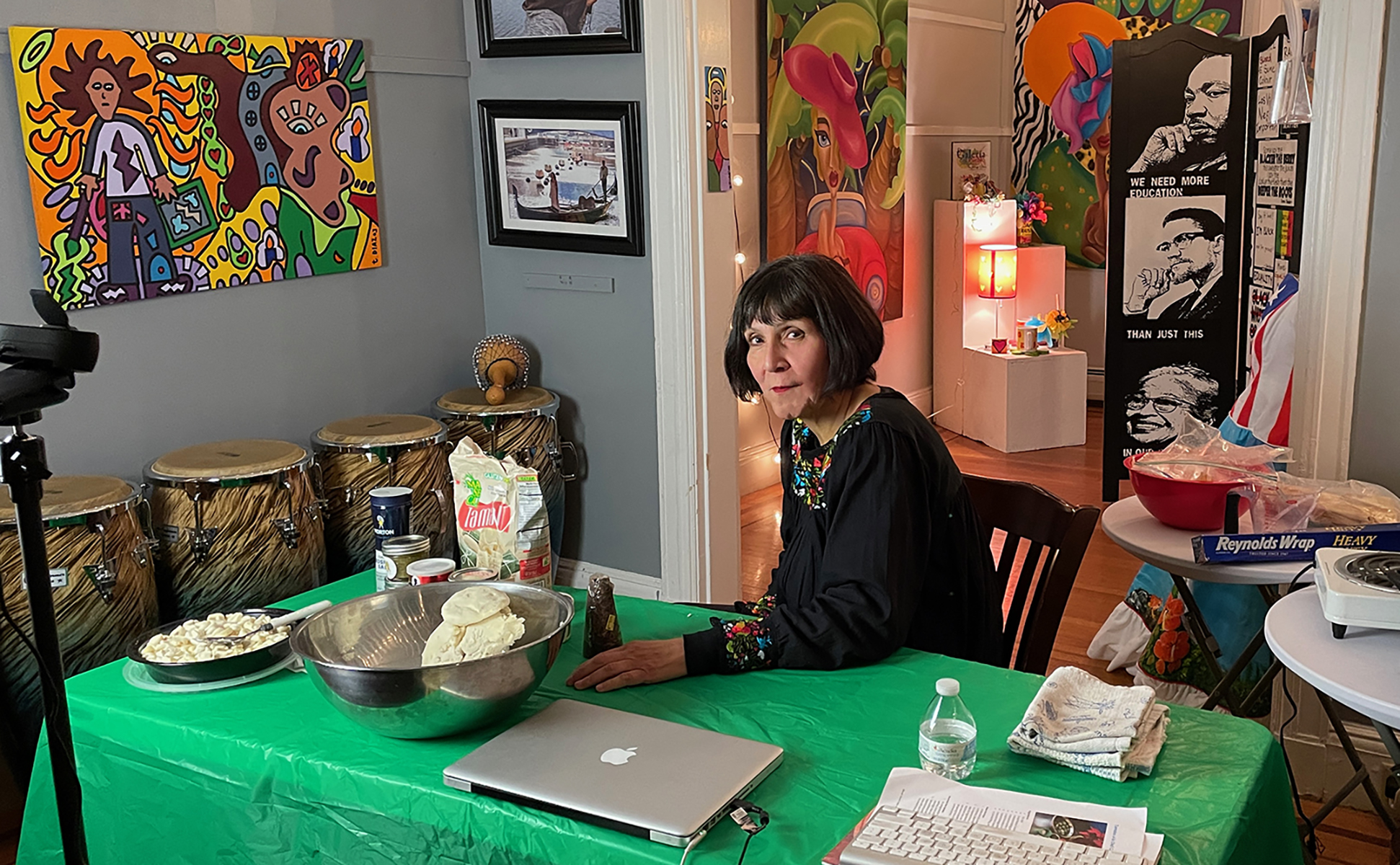
At Rhode Island Latino Arts, we hosted an exhibit called Portraits of Guadalupe, inviting artists from our community to create their own interpretations of the beloved figure. Artists from Dominican, Puerto Rican, Cuban, and Mexican backgrounds submitted work reflecting their personal relationships with Guadalupe. Some paintings stayed close to the traditional devotional image. Others reimagined her in contemporary ways, through vibrant color and symbolism.
What emerged in the gallery was not one Guadalupe, but many. Each artist carried their own memory, their own story, their own connection.
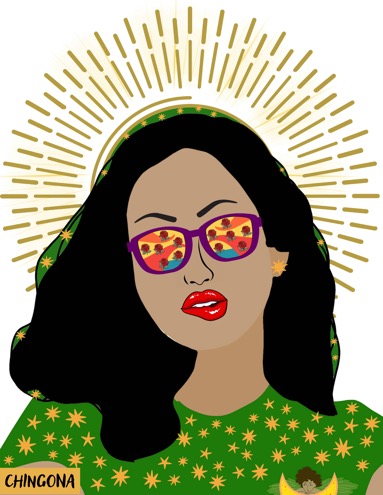
While preparing the exhibit, I decided to create a piece of my own, but instead of painting the familiar image we see in churches, I wondered something slightly mischievous. What would Guadalupe have been like when she was young? In my piece, I imagined her in her early twenties. A confident young woman with bright sunglasses and a playful spirit who calls herself Lupita, La Morenita. The roses of her future appear reflected in her lenses, hinting at the miracle story that will one day define her. An angel rests near her heart, quietly guiding her toward the powerful symbol she will become. That patch on her right sleeve emphasizes how I would have described her to someone who does not know her in today’s world.
Creating that piece made me realize something. Guadalupe has always been more than a religious icon. She is a cultural companion. She lives in the homes of families who light candles in her honor. She appears in murals across neighborhoods. She travels in the memories of people who carry their heritage with them wherever they go. And sometimes, she appears at turning points in our lives when we are searching for connection. For me, one of those moments happened in a chapel at Providence College on December 12, 1977. Nearly fifty years later, I can still see her there.
And perhaps that is why, when I look at the artwork hanging in our gallery today, I am reminded of something simple and profound. That the symbols we carry with us do not remain frozen in time. They grow with us. They follow us through memory, through art, and through the quiet moments when we realize that something—or someone—has been walking beside us all along.